Explore how entertainment quietly shapes the way we think, desire, and choose. Behind every story, brand, and screen lies a deeper psychology at work.
The Thinking Chamber
By Shivangi S
Published May 7, 2026
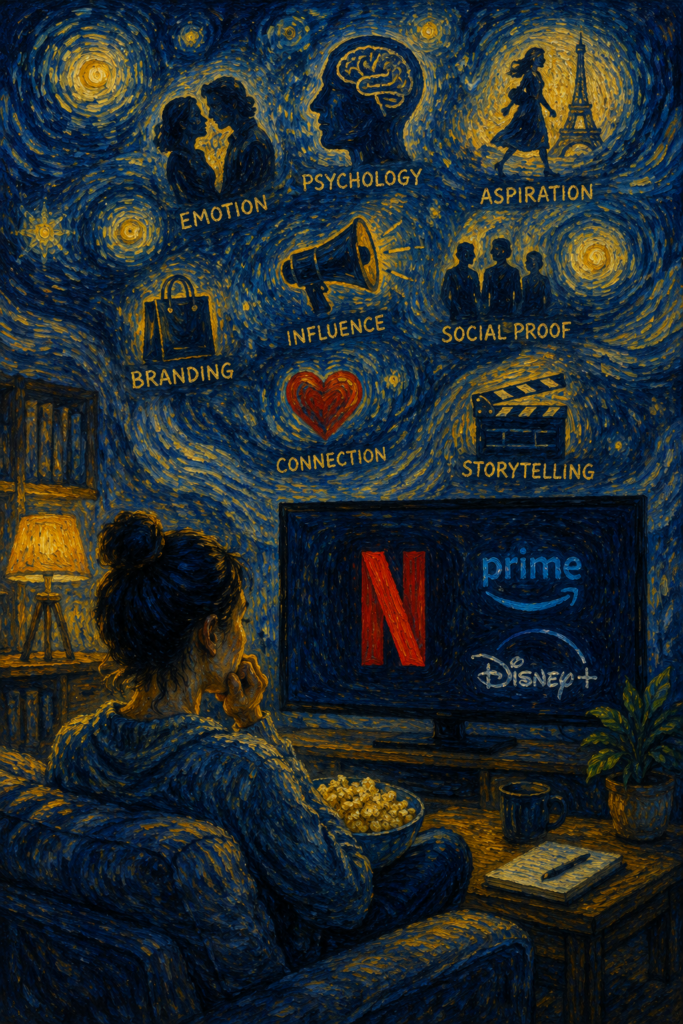
Ever get the feeling that your favorite shows and movies are quietly teaching you something beyond the story itself?
The next time someone tells you to “stop watching so much OTT,” invite them into the experiment instead.
Watch closely.
Not just for the plot twists or dramatic endings, but for the invisible psychology unfolding underneath them.
Because once you begin noticing it, entertainment stops feeling passive.
It starts revealing how people think, desire, trust, fear, and choose.
Customer psychology is everywhere.
It’s debated in boardrooms, studied in textbooks, and quietly woven into films, advertisements, social media, and storytelling.
Sometimes we notice it immediately.
Most of the time, we don’t.
Take Aditya Dhar’s now-famous “Doodh Soda” moment.
A simple, unusual idea suddenly became culturally memorable. Instagram reels, food creators, and curiosity-driven conversations turned it into an experience people wanted to try for themselves.
Not because anyone needed it.
Because people wanted to feel part of the moment around it.
That’s the fascinating part about modern consumer behavior.
Some brands appeal to logic.
Others trigger emotion, curiosity, identity, or belonging.
And often, the strongest influence happens quietly- through framing, repetition, aspiration, social proof, and emotional association.
When Entertainment Starts Looking Like Psychology
Take Emily in Paris.
On the surface, it feels glamorous, chaotic, and playful.
But beneath the fashion and drama, the show almost functions like a visual lesson in customer psychology.
Emily rarely sells products directly.
She sells feelings around them.
Confidence. Luxury. Belonging. Attention. Identity.
A perfume becomes romance.
A café becomes an aesthetic experience.
A product becomes part of a lifestyle people want to emotionally enter.
And that’s what many successful brands actually do.
They don’t just market products.
They market emotional worlds.
One small campaign in the show might seem exaggerated at first.
But if you watch carefully, you’ll notice how often modern branding revolves around emotional connection rather than utility alone.
People remember what makes them feel something.
Even when they forget the product itself.
Why Steve Jobs Wanted the Macintosh to Say “Hello”
One of the most interesting examples of customer psychology appears in Jobs during the Macintosh launch.
There’s a moment where Steve Jobs becomes furious because the computer’s voice demo isn’t working properly.
He insists that the Macintosh must say:
“Hello.”
At first glance, it seems unnecessary.
Why obsess over a single word?
But psychologically, it changed everything.
Before personal computers became emotionally approachable, many people saw technology as:
◈Cold
◈Complex
◈Intimidating
The Macintosh saying “Hello” subtly reshaped that relationship.
Suddenly, the machine felt welcoming.
Human.
Almost friendly.
What Jobs understood was something deeper than product design:
People connect more easily with things that feel emotionally familiar.
He wasn’t only launching a computer.
He was reducing fear around technology itself.
Even today, many modern marketing systems still revolve around the same principle.
Different industries simply use different language for it:
◈Neuromarketing
◈Sentiment analysis
◈Customer intelligence
◈Experience design
But the intention underneath remains surprisingly similar.
To understand people more deeply.
To reduce hesitation.
And to make decisions feel emotionally easier.
The Psychology Behind Simplicity
A lot of modern customer psychology revolves around one quiet idea:
People are mentally tired.
Every day, they process endless choices, comparisons, advertisements, and information.
So naturally, the human brain begins looking for:
◈Familiarity
◈Clarity
◈Emotional reassurance
◈Simplicity
This is why brands invest so heavily in reducing friction.
Not just physical friction.
Mental friction.
The easier something feels to understand, trust, or emotionally relate to, the easier it becomes to choose.
Sometimes people don’t buy the “best” option.
They buy the option that feels easiest to process emotionally.
Why Stories Influence Us More Than Facts
Facts inform people.
Stories move them.
That’s why entertainment becomes such a powerful psychological space.
When people emotionally enter a story, their resistance lowers.
Ideas begin to feel personal instead of instructional.
A luxury brand inside a film doesn’t feel like an advertisement.
It feels aspirational.
A café in a romantic series suddenly feels desirable.
A lifestyle starts looking emotionally meaningful.
Without realising it, viewers begin associating products with identity, emotion, and memory.
And once emotion enters a decision, logic rarely works alone anymore.
When You Start Seeing It, You See It Everywhere
After a certain point, it becomes difficult to “unsee” these patterns.
You begin noticing how:
◈colours influence trust
◈music changes perception
◈repetition creates familiarity
◈scarcity creates urgency
◈storytelling creates attachment
Entertainment stops being “just entertainment.”
It becomes a reflection of how persuasion quietly exists in everyday life.
Not always manipulatively.
Sometimes creatively.
Sometimes beautifully.
Sometimes so subtly that we mistake influence for instinct.
Final Thought
The most influential brands are not always the loudest.
Often, they are simply the ones that understand human behaviour more deeply.
They know people rarely buy products alone.
They buy emotions.
Experiences.
Identity.
Comfort.
Belonging.
And maybe that’s why certain shows, advertisements, and stories stay with us long after we finish watching them.
Because beneath the entertainment, they were never only telling stories.
They were teaching us how people work.
ShivangiS
May 7, 2026