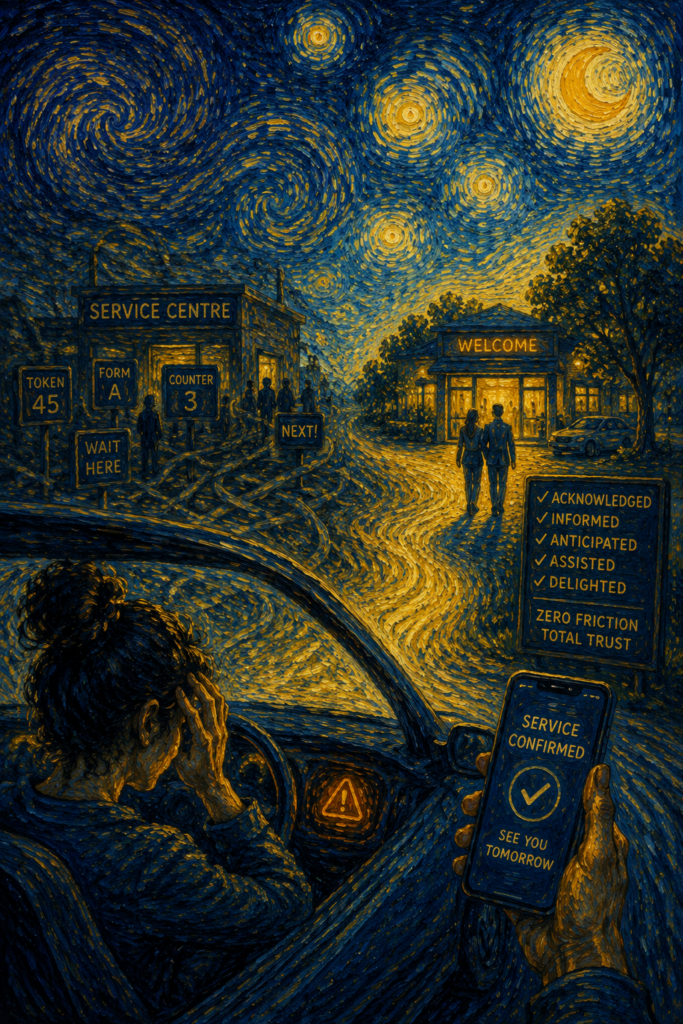
A car service story about the invisible exhaustion businesses create.
Explore how friction quietly shapes trust, emotion, and customer experience. What exhausts people most is often the effort they were never meant to feel.
The Thinking Chamber
By Shivangi S
Published May 8, 2026
Our morning began peacefully with a quiet stroll through the park.
But on the drive back home, the dashboard suddenly flashed an urgent warning:
“AdBlue Fluid Low.”
Impossible to ignore.
If left unresolved, the car would eventually refuse to move.
So before the day had even properly begun, my husband quickly booked an appointment at the nearest authorized Service Centre.
We expected a simple fix.
What followed felt anything but simple.
The executive barely acknowledged us before sending us to the reception counter, where-without even lifting his gaze-we were redirected toward the AdBlue section.
No greeting.
No guidance.
No clarity.
At the counter, the attendant silently took our details and handed over a heavy bucket of AdBlue fluid as if this was perfectly normal.
No instructions.
No explanation.
Just a cold transaction.
As we walked further inside, the absence of communication became impossible to ignore.
Every small moment added friction.
Not dramatic frustration.
Just quiet exhaustion.
The kind that slowly chips away at trust.
Eventually, a technician arrived and asked for our car.
We followed him, only to realize he wasn’t entirely sure where the AdBlue fluid even needed to go.
After we pointed it out ourselves, he opened the bucket and casually handed my husband the pipe to help with the refill.
For a moment, it genuinely felt as though we had become part of the servicing process ourselves.
And strangely, that was the most exhausting part of all.
Not the waiting.
Not the cost.
The effort.
It made me wonder how many businesses unknowingly create fatigue through experiences like this.
Because friction is rarely measured properly.
And yet customers feel it immediately.
Now imagine the same situation unfolding differently.
Not dramatically.
Just intelligently.
The warning light appears again:
“AdBlue Fluid Low.”
But this time, instead of anxiety, there’s clarity.
The car is already connected to the service app.
The issue is automatically detected.
Within seconds, a notification appears:
“AdBlue refill recommended. Would you like to schedule a quick service? Estimated time: 20 minutes.”
My husband taps “Yes.”
Appointment confirmed.
Simple.
The next morning, as we arrive at the Service Centre, there’s no confusion.
No wandering between counters.
No repeating information.
A screen near the entrance already displays our vehicle number.
A service advisor approaches us directly.
Smiling. Prepared. Aware.
“Good morning, Mr. and Mrs. Srivastava. We’ve been expecting you. AdBlue refill, right?”
And suddenly, everything feels lighter.
No forms.
No explaining the issue again.
No carrying buckets across the workshop floor.
The advisor handles everything seamlessly.
▶ Parts? Already arranged.
▶ Billing? Pre-generated.
▶ Technician? Waiting beside the bay.
We’re guided toward a comfortable lounge instead.
“Please relax. We’ll take care of everything. It should take around 15–20 minutes.”
And for the first time that morning, the experience feels effortless.
Behind the scenes, the technician already knows exactly what needs to be done.
▶ Correct fluid
▶ Correct process
▶ No guesswork
We never see the chaos because there isn’t any.
Only quiet efficiency.
The kind customers rarely notice consciously, but always remember emotionally.
Before we even finish our coffee, the advisor returns.
“Your car is ready. AdBlue has been refilled, and we’ve also completed a quick vehicle health check. Everything looks good.”
The invoice is already available on the phone.
Payment takes one tap.
No unnecessary movement.
No mental load.
And then comes something interesting.
Not a sales pitch.
A thoughtful suggestion.
“Based on your usage, your next service is likely due in around 20 days. Would you like us to schedule it now at your convenience?”
The difference is subtle, but important.
The recommendation doesn’t feel forceful.
It feels helpful.
Relevant.
Timed correctly.
That’s when it becomes clear:
The best upselling rarely feels like selling.
It feels like understanding.
As we drove back home, every trace of frustration had disappeared.
Not because the refill itself was extraordinary.
But because the experience demanded so little effort from us.
And
Maybe that’s what truly defines a frictionless experience.
Not doing more for the customer.
But removing the unnecessary effort they were never supposed to carry in the first place.
Because most people are already mentally exhausted.
They are navigating traffic, notifications, deadlines, decisions, and constant interruptions every single day.
The last thing they want is to struggle through systems that should have been designed to help them.
The most satisfying experiences are often the quietest ones.
No repeated explanations.
No unnecessary movement.
No confusion.
No uncertainty.
Just clarity, anticipation, and seamless flow.
And perhaps that’s the real insight businesses often miss.
Customers may not always remember every detail of a great experience.
But they always remember how effortless it felt.
Written through the lens of real-world experience within automobile service environments.
ShivangiS
May 8, 2026